
Hi! I’m Vaibhavi.
A KM strategist, LX designer, and AI-enablement nerd – professionally allergic to disorganized information.
I’ve spent my career across loyalty, contact centres, and STEAM education, picking up the same lesson everywhere: information without structure is just noise. So I tame it, shape it, and make it useful – for humans and the AI systems trying to keep up.
Curious how this path came together?
Recent Work
From content chaos to a decision‑support system
A legacy knowledge base had grown into a maze – every search a guess, every document a dead end waiting to happen. I rebuilt it into a structured, metadata-driven ecosystem with clean IA and defined ownership, laying the groundwork before AI ever arrived.
The result: a system that turns “where is that process?” into “here’s exactly what you need”; ready for whenever AI lands.
Preparing an organization for AI the right way
Most organizations want AI results before their knowledge foundations can support them. I built a practical, crawl-walk-run roadmap connecting KM fundamentals to AI readiness – trusted content, structured workflows, and clear governance.
The result: a phased path to real-time decision support, built for both today’s tools and tomorrow’s agentic AI.

Passion project:
Children’s Book Creation
When introducing my kids to family’s faith, I couldn’t find the right resource – plenty of individual stories, but nothing that showed how they fit together. So I built one myself: researching with religious leaders, testing concepts with real kids, and refining until it clicked.
The result: a playful, illustrated counting book that helps parents introduce their faith accurately, and joyfully.
AI Prototypes & Practice Projects
AI App TaskIt
I planned and created an early prototype for this app in about 5 hours. TaskIt helps busy team leads turn meeting notes into tasks that get done.
You paste in your notes, and AI pulls out each action item, works out who owns it and turns phrases like “by Friday” into real dates. Anything unclear goes to the team lead and is flagged for review. Once the list is confirmed, the tasks move to a simple board, where they’re tracked from To do to Done. You can also see the concept diagram, mockups and project plan.
Tools: Claude for planning, the product plan and mockups; Google Antigravity, an AI coding agent, to build the app; Google Gemini to read the notes and extract tasks; GitHub for the code; and Vercel for hosting.

AI Ad – Aura Beans: “Magical Morning”
This is a short commercial I made entirely with AI tools in a 60-minute challenge.
It follows a tired woman through a frustrating morning, from slamming her alarm to slumping at the kitchen table, until a bag of Aura Beans coffee magically appears in a burst of light. One sip later, she smiles at the camera: “Aura Beans. Pure morning magic.”
Tools: Nano Banana (in Gemini) for the character, set and product images; Veo in Google Flow to animate the scenes and generate audio; and Canva for the final edit.
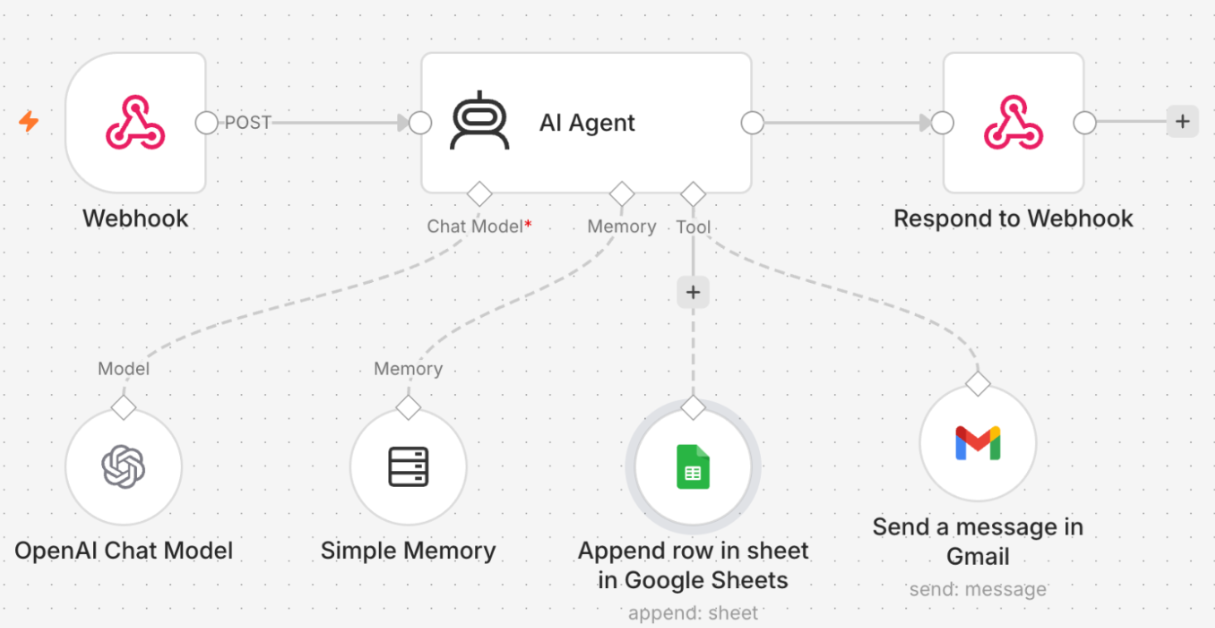
AI automation – Triage Bot
This is a working support system that sorts customer feedback automatically.
A customer fills in a simple web form with their name, email and message. AI then reads the message, writes a one-line summary, labels it as a bug, feature request, complaint, question or praise, and rates how urgent it is. Every ticket is logged to a shared tracker, and the customer gets a friendly acknowledgement email right away. Anything marked high urgency is escalated to the support team straight away, so critical issues aren’t missed.
Tools: Lovable for the customer-facing form; n8n for the automation workflow, connected to the form through a webhook; OpenAI (GPT-4.1 mini) for classification; Google Sheets for the ticket log; and Gmail for the acknowledgement and escalation emails.
Good information doesn’t happen by accident.
It’s designed.
Got a content mess, a learning gap, or AI plans your foundation isn’t ready for? Let’s talk.